Google I/O Connect Berlin 2025: AI, XR and community

Google I/O Connect Berlin 2025 was more than a technical event: it was an immersion into the future of development. Julieta Zalduendo, writer of this article and founder of My Tech Plan, and above all your servant, had the privilege of attending representing the Google Developer Groups as chapter lead of GDG Valencia and Women Techmakers Valencia, accompanied by part of the team. Here is a summary of my first experience at this event.
AI News: Gemma and Gemini are going strong
Gemma 2 was presented as a powerful open-source proposal in 9B and 27B versions, designed to democratize access to large models without depending on heavy infrastructure. Now available on Hugging Face, Kaggle, and AI Studio, ideal for experimenting and integrating without friction.
Gemini 2.5 Pro is consolidating as the most robust model in extended context, code execution, caching, and real multimodal support. During the demos, we could see how Gemini Live detects objects via the mobile camera, interprets the scene, and responds in real time. Ideal for developers who want to explore new UX/AI flows.
Creative AI: image, audio, and video
Veo 3 generated a lot of buzz. It creates video scenes with audio, atmosphere, and narrative from text. Combined with Imagen 4 and interfaces like Google Beam (3D video calls without glasses), the possibilities for creative production are enormous. This suite is integrated directly into the Gemini stack, allowing full control from the API.
Here is a video that you could make with different effects at a VEO 3 stand.
The Gemini API now thinks like a dev
The new version of the API brings support for 2M tokens, asynchronous interaction, and tools like Jules, an agent that works in parallel with you and suggests code, checks for errors, or generates scripts. Google’s focus is clear: models are not assistants, they are code copilots.
In addition, there are open initiatives such as free courses on Udacity and a global challenge where the prize is an electric Delorean. Because yes, the future has a sense of humor.
Android XR and the leap to wearable computing
One of the most talked-about demos was that of Android XR: an extended, open platform designed for smart glasses. With WebXR, OpenXR, gestures, voice, and eye tracking integrated, what we saw was a system prepared for immersive, useful, and, above all, scalable experiences. The prototype we tested showed simultaneous translation, guided navigation, and object recognition, all integrated with Gemini.
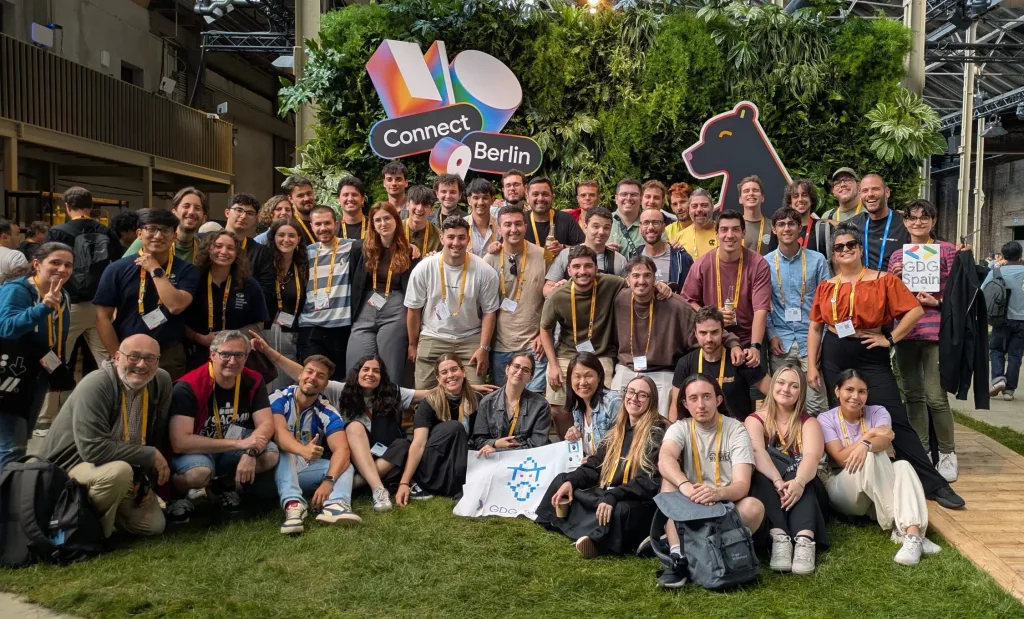
Many, though not all, of the leaders of the different GDG chapters from all over Spain. Diversity, long-standing friendships, and the happiness of meeting again.
Community and connections that matter
Beyond the technology, the most powerful thing (for me at least) was connecting with other leads, developers, and Google teams. We also had the opportunity to participate in the GDG Summit, an exclusive meeting where community leaders from all over EMEA and APAC shared learnings, challenges, and future visions. It was a space of very high value, especially for community builders, where we not only discussed how to scale communities, but how to make them more inclusive, sustainable, and technically relevant. From exploring new dynamics for tech events, to generating real synergies between chapters, this trip confirmed something for us: community is the strongest engine of innovation.